


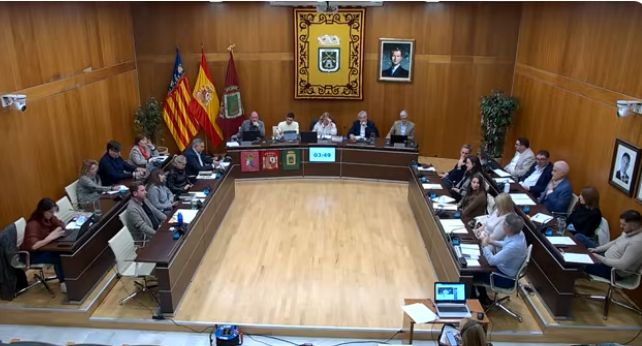
Today's plenary session officially announced Juan Manuel del Pino's resignation as councillor, which he submitted a few days ago at his own request. During the current term of office, Juan Manuel del Pino has been deputy mayor and responsible for Urban Planning, Infrastructure and Urban Quality, Parks and Gardens, Water Cycle, Street Cleaning and Solid Urban Waste. In addition, during the previous term of office, he was responsible for Urban Planning and Territory, Water and the Environment.
Several weeks ago, the councillor announced his decision to leave political life after the final approval of the budgets, thus closing a six-year period in public administration to devote more time to his family and his profession.
The mayoress, visibly moved, praised Juan Manuel del Pino's management of urban planning and territory, water and solid urban waste management, stating that ‘you are one of the best things that has happened to this council’.
Juan Manuel del Pino said, ‘I came to Calp 40 years ago, I have always been interested in helping through my medical profession and then I was able to do so as a public servant. I have felt great satisfaction in working for my town, I have learned a lot from all of you, and I want to thank Ana Sala for the opportunity to experience this exciting adventure’.
Final approval of the 2026 budget.
The government team has definitively approved the municipal budget for the 2026 financial year, with a total amount of €45,867,550, with the opposition groups voting against it. The plenary session rejected the allegations presented by the Popular Municipal Group and the Defendamos Calpe Group.
The budget proposal responds to a context marked by the return of fiscal rules and increased costs. The economic solvency of the Town Council has allowed it to open two interest-bearing accounts that will generate an expected income of €695,100 in 2026.
Fiscal measures that provide relief to families and businesses
The revenue budget preserves stability and maintains measures that favour local economic activity: the exemption from the business start-up tax is extended, as is the 95% rebate on inheritance transfers, the property tax rebates for the installation of solar panels and energy efficiency improvements, and the 5.04% reduction in the urban property tax rate is maintained.
In addition, €575,000 per year in revenue is incorporated from the new regulated parking contract, and fees for terraces and events in the low season are suspended as a measure to support commerce and the hospitality industry.
Efficient and service-oriented spending
Current expenditure is reduced slightly (-2.37%) but key services are maintained and even improved: street cleaning, beach cleaning, lifeguard services and urban maintenance. A budget item is included to celebrate the 50th anniversary of the “Moros y Cristianos” festival, and another to launch the 1st Calp Nationalities Fair.
In current transfers (subsidies), the budget is increased by 15.61% to 4.57 million euros, which will make it possible to strengthen areas such as housing assistance, the youth rental voucher, subsidies for hybrid and electric vehicles, property tax rebates for energy efficiency improvements and transport assistance for students. A line for social projects by local non-profit associations has also been added. The Public Transport Plan is included in this chapter with a budget of £460,000 for the expansion and reorganisation of routes and timetables.
A planned investment geared towards real needs
The investment chapter amounts to €3.6 million, compared to almost €13 million last year, representing a 72% decrease as this year's budget does not include the Pla Edificant actions corresponding to the new IES and the adaptation of the plot for the Gargasindi public CEE.
The investments include the adaptation of Vial J (€320,000), the Vial T urbanisation project (€100,000), repairs to the Calalga promenade (€100,000), Barranc del Quisi (€100,000), the reinforcement of lighting in residential areas (€154,000), the accessibility of pavements (€250,000), sanitation and storm drains (€1,106,134), the electrical connection of the IES Les Salines secondary school (€150,000), the restoration of the Pierre la Fleure mural (€60,000), the expansion of urban gardens (€45,000), the Manzanera dog park (€121,000) and improvements to the Ifac sports hall (€115,000). A budget has also been allocated for drafting strategic projects to be financed with surpluses, with priority given to housing initiatives.
In addition, multi-year projects are being consolidated until 2029 to ensure their phased and effective implementation, such as the renovation of the Fossa promenade, the improvement of the beach washing system, the renovation of the Plaza Mayor, the new 21st-century tourist office, and the new CRISOL (recovery centre for people with mental health problems).
The state of the municipality
Summary of Mayoress Ana Sala's speech in the debate on the state of the municipality:
"In 2025, 390 tenders and 515 minor contracts have been processed. And almost €1.9 million in subsidies have been obtained from other administrations, in addition to a Programme Contract in social services worth over €1.5 million, which will enable us to better sustain the services provided daily.
In tourism and economic promotion, Calp has joined the National Network of Smart Tourist Destinations, with a 66.5% compliance rate and an outstanding rating in sustainability. According to the mayor, occupancy figures confirm that progress is being made towards a seasonally adjusted destination: a new record in October with 80.68% occupancy, with increases in hotels, campsites and tourist apartments.
The Tourism Sustainability Plan has been rolled out with Next Generation funds, the Local Action Plan has been launched to mobilise up to £15 million in European funds, and the Pla d'Habitatge (Housing Plan) is being drafted to reconcile tourism with the right to housing.
Another initiative has been to strengthen our brand with the ONCE coupon, with the ‘Gamba Blanca de Calp’ brand, with participation in Alicante Gastronómica, FiraCalp, Fira Nadal and campaigns such as the Bonos Comercio or ‘El comercio de Calp te da la bienvenida’ (Calp's businesses welcome you), always in collaboration with AEMCO, CREAMA and the Fishermen's Guild. Calp has also been consolidated as a sports and cycling destination with the agreement with Soudal Quick-Step and our presence at the Networking Day in Brussels.
In terms of infrastructure and the water cycle, Avenida Felipe VI (Vial J) has been opened, a new strategic connection that improves mobility and alleviates traffic in beach areas; the school zone and roads in Basetes, Calalga and La Fossa have been resurfaced, the Balcó de Bernia road has been improved and the cemetery has been expanded with 111 new niches.
The government team has begun improvements to the Arenal-Bol promenade and given strategic impetus to the future Fossa promenade, the Plaza Mayor and the new 21st-century Tourist Office, within the framework of the Urban Agenda.
Through Aguas de Calpe, work worth more than €1 million has been completed on reservoirs, pipelines and sanitation, and work worth €3.8 million is underway, including the refurbishment of the Barranc Salat desalination plant and the DIGITAMED project to digitise the water cycle. Thanks to these efforts, Calp has exceeded 90% hydraulic efficiency, making it a national benchmark.
In terms of public safety and emergencies, human and material resources have been reinforced. The Local Police has planned a special summer operation for a floating population that can exceed 140,000 inhabitants; we have created the Coastal Surveillance Unit, with a new boat that has already been used in rescues in the Penyal d'Ifac area; progress has been made in the first phase of video surveillance on the main roads and in the selection process for 11 new positions, more commanders and new operating regulations.
In Civil Protection, the new headquarters has been put out to tender and a rapid response motor pump has been purchased, which has already prevented the spread of several fires, and Calp has hosted the Regional Water Rescue Conference.
In terms of beaches, a new comprehensive lifeguard and rescue contract has been awarded, with up to 32 professionals in summer and an adapted bathing service with transport for people with reduced mobility.
In terms of culture and heritage, Calp has consolidated its position as a regional and provincial benchmark: €100,000 in grants for cultural and artistic training, exhibitions on La Pobla d'Ifac and Roger de Llúria, guided tours of the historic quarter and the regular opening of the Queen's Baths with tours in four languages.
The programme has been reinforced with initiatives such as the Calp Piano Festival, the SOMIART street theatre festival, the CALPSULES micro-experiences, the Nit Encesa in the old town and the restoration of historic murals.
In education and youth, the 2025–2026 academic year has begun with 3,541 students in the municipality, and a comprehensive maintenance contract for educational centres has been implemented, which is already improving playgrounds, shade, fencing and basic elements of schools and nurseries.
€140,000 in transport subsidies for post-compulsory education and €100,000 in subsidies for cultural and artistic training have been allocated.
Calp has joined the UNED Senior programme for the first time, the third edition of the #goCalp school competition on climate change has been launched, and in the area of youth, a youth technician has been appointed, the Youth Club has been consolidated, and a group of youth correspondents involved in the programming and promotion of activities has been created.
In sports, a leap forward has been made in planning and supporting the sports fabric: creation of the Municipal Sports Council, approval of the municipal swimming pool regulations and a call for €250,000 in grants for clubs and events, reinforcing grassroots sport.
The municipal swimming pool has been modernised with solar panels, improvement works and an extension of opening hours and groups, making it a more efficient facility with more users and more activities.
The 1st Sports and Culture Gala were held to recognise emerging talent, we successfully participated in the MiniJocs de la Marina Alta and next month the Costa Blanca Bike Race 2026 will be held, consolidating Calp as a year-round sports destination.
At the Civic Centre, a long-standing problem with reverberation has been solved with an acoustic improvement project, and we have launched new workshops for older people (languages, writing) that combine socialisation and cognitive stimulation.
In terms of citizen participation, the Strategic Participation Plan has been put out to tender, which will allow for the organisation of councils, channels and processes so that the people of Calp have more and better ways to participate in public affairs.
In terms of the environment, beaches and lighting, posidonia has been managed according to environmental and tourist quality criteria, the Blue Trail distinction has been revalidated on the Voramar Calalga trail, and reforestation and environmental education days have been organised.
The Public Lighting Master Plan has been promoted, solar streetlights in residential areas have been reviewed and expanded, the naturalisation of the Quisi and Pou Roig ravines has been initiated, the Empedrola pine forest has been cleaned up, and perimeter strips have been created in the Serra d'Oltà with Next Generation funds to prevent fires.
Progress has been made on the Calp Traditional Trail, the Calp Blau conference has been held, actions have been coordinated with the LIBERA Project against ‘littering’ and collaboration with Alicante Renace has begun on the ecological restoration of the salt flats.
In animal welfare, the new veterinary contract, the ordinance on coexistence and animal welfare and the ethical plan for the management of cat colonies have been implemented, moving towards more responsible and respectful management.
In terms of social welfare, work has begun on improving accessibility to the Social Services building, the Single Social History has been implemented as a pilot municipality in the province, the Programme Contract has been renewed to better cover services such as the Civic Centre and the Alzheimer's unit, new vehicles have been provided for the SAD and adapted transport, and the workforce has been stabilised through competitive selection processes.
We have launched the Escola d'Acollida (Welcome School) for migrants and guaranteed transport for users of the Maite Boronat Occupational Centre.
In terms of equality, we have continued to feminise public spaces with new street names and murals, created the Punt de la Sororitat, approved the II Internal Equality Plan and the I Equality Plan for citizens, and activated the Committee for the Prevention of Trafficking and Prostitution.
In terms of health protection, the government has continued to call for a second health centre and to make municipal land available to the Generalitat; Healthcare staff has been increased, the Addictive Behaviours Unit has been incorporated, the First Municipal Plan for the Prevention of Addictive Behaviours has been approved, and progress has been made in making Calp a heart-safe municipality, with the allocation of 28 defibrillators for the police, civil protection, public buildings and high-traffic areas. In addition, the preventive ambulance service for municipal events has been awarded.
During the debate, the spokesperson for Defendamos Calpe, Paco Quiles, pointed out that ‘our perspective should be taken into account as an opportunity to improve, to really solve the problems of the municipality’. Quiles criticised waste management throughout 2025, traffic management, the lack of sanitation, the management of the health transport service and education, and placed particular emphasis on urban planning, stating that ‘we have an outdated general plan that does not solve the major problems of our town’.
The spokesperson for the Popular Party, Miguel Crespo, has criticised the municipal management monthly, emphasising the lack of a blue parking zone, delays in lifeguard services, the lack of footbaths on the beaches, delays in contracts for sunbeds and parasols on the beaches, and the closure of Bol beach on two occasions during the summer due to pollution. Crespo also questioned the declassification of 300,000 m² at a valuation of €5.37/m² and the loss of ERDF funds and criticised the opening of the J road without inviting representatives from the Provincial Council, which financed the project.
The councillor for the Socialist Group, Marco Bittner, thanked the opposition for its conciliatory mood but pointed out that the opposition's vision is based on discrediting the government team, which ‘has proven that it manages better than you do’.
The spokesperson for Compromís, Ximo Perles, reproached Defendamos Calpe for ‘requesting a review of the general plan, but when we bring specific amendments to reduce urban pressure, you vote against them’. Perles also reproached the Popular Party group for ‘saying that there is a lack of budget management and then telling us that we are overspending with our Economic Financial Plan’.